
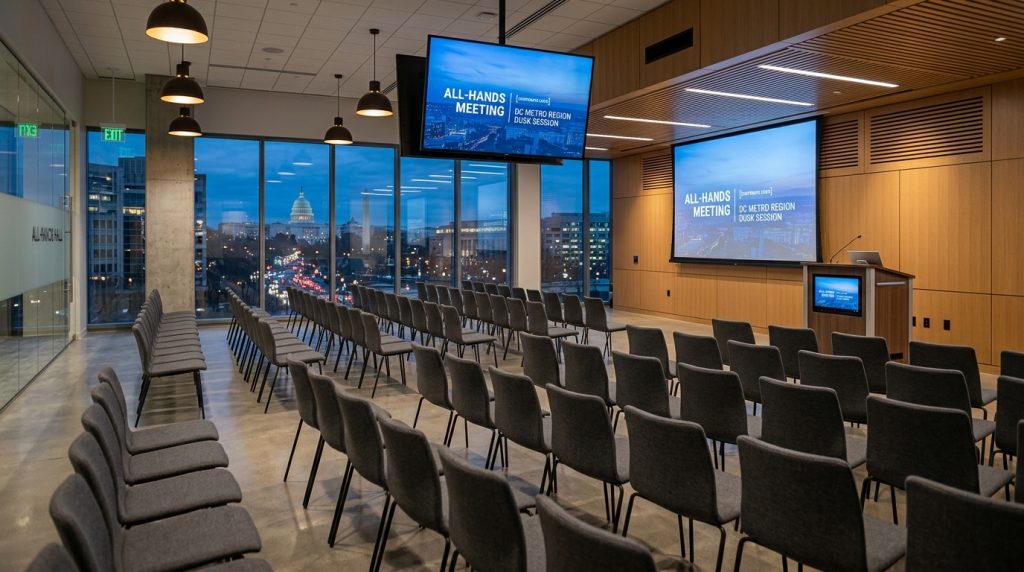
All-Hands Rooms and Town Hall Spaces: Designing Large-Format Gathering Areas
Whether you’re a federal agency in Crystal City, a tech firm in Tysons Corner, or a nonprofit headquartered near Dupont Circle, large-format gathering spaces are becoming a fixture of modern organizational life. All-hands meetings, company-wide town halls, leadership forums, training days — these events demand rooms that can handle a crowd without sacrificing function, acoustics, or comfort. Getting the furniture and layout right is the difference between an energizing gathering and an exhausting one.
What Makes a Great All-Hands Space?
The best large-format gathering rooms share a few defining qualities: clear sight lines to a central presentation point, strong acoustics that let a speaker’s voice carry without distortion, enough seating to accommodate the full group, and enough flexibility to reconfigure the room for different event types. A space that works brilliantly for a 200-person quarterly update should also be adaptable for a 60-person training session or a departmental offsite — without requiring a full-day reset.
In the Northern Virginia and DC metro market, many organizations are working within buildings that weren’t originally designed with large gathering rooms in mind. Older office buildings, converted warehouse spaces, and government-adjacent facilities all present unique challenges. The right furniture strategy can bridge those gaps effectively.
Seating Considerations for Large Gatherings
Seating is the most visible element of any large-format space, and the options matter more than many organizations realize. The three most common approaches each have distinct trade-offs:
Stackable and ganging chairs are the workhorses of all-hands rooms. Modern stackable chairs have come a long way from the folding chair aesthetic of years past — quality stacking chairs now feature contoured seats, lumbar support, and durable upholstery that hold up through years of heavy use. Look for chairs that gang together (link side-by-side) to maintain clean row alignment during presentations, and stack efficiently for compact storage when the room converts to another purpose.
Tiered or risered seating is ideal for permanent or semi-permanent town hall configurations where sight lines are a priority. Riser systems allow rear attendees to see over the heads of those in front without straining, dramatically improving the experience for large groups. In the DC metro area, we frequently see this approach in government training facilities, association headquarters, and large law firms with regular all-staff programming.
Soft lounge seating clusters work well when an organization wants to create a less formal, more town hall-style energy — breaking the auditorium feel and encouraging engagement rather than passive attendance. This approach requires more square footage per attendee but can significantly improve participation in interactive formats.
Flexible Tables for Multi-Use Versatility
Not every large gathering is purely presentational. Training events, breakout discussions, and working sessions all require surface area. Flip-top and nesting tables are the standard solution here: they fold flat and nest together on mobile carts, allowing a room to shift from theatre-style seating (chairs only) to classroom style (chairs plus tables) within minutes. This is particularly valuable in organizations that host both passive town halls and active workshop formats in the same space.
Modular table systems that connect in various configurations — chevron, U-shape, boardroom — add another layer of versatility. For organizations running hybrid meetings where in-room participants need to collaborate with remote attendees, modular tables make it easier to position seating around integrated AV and camera systems.
When desks and worksurfaces are part of your broader space planning, All Business Systems’ sit-stand desk solutions integrate well into adjacent work areas and training rooms where facilitators need surface height flexibility throughout long event days.
AV Integration and Technology Planning
Modern all-hands spaces live or die on their AV infrastructure, and furniture choices directly affect how well that infrastructure performs. Cable management built into table systems keeps presentation areas clean and safe. Power modules integrated into tabletop surfaces allow participants to charge devices during long sessions. Furniture height and depth need to be planned alongside screen placement and projection throw distances — a table that’s too tall can obstruct lower-mounted displays; seating that’s too wide can push attendees beyond comfortable viewing angles.
For hybrid meetings — now standard across the DC metro region — camera placement is critical. Low-profile furniture at the front of the room allows fixed cameras to capture all in-room attendees without obstruction. This is a detail that’s easy to overlook when selecting seating but difficult and expensive to correct afterward.
Acoustics and Sight Lines: The Invisible Infrastructure
Even the most beautifully furnished all-hands room fails if participants can’t hear the speaker or see the screen. Acoustic treatment — wall panels, ceiling baffles, carpet or acoustic flooring — reduces reverberation that makes speech intelligible in large hard-surfaced rooms. Upholstered seating contributes meaningfully to acoustic absorption, which is one reason quality fabric chairs outperform hard-shell alternatives in large gathering spaces beyond just comfort.
Sight lines should drive the room layout before any other decision. Map the worst-case seats first: the far corners, the back row, the seats adjacent to columns or support structures. If those positions don’t have clear views to the primary presentation point, reconfigure the layout or supplement with secondary displays before finalizing the furniture plan.
Planning for the Full Event Lifecycle
A well-designed all-hands space accounts for the full arc of any event: setup, the event itself, and breakdown. Furniture that’s difficult to move, heavy to lift, or awkward to store adds real labor cost to every event. This is where commercial-grade stackable chairs, wheeled table carts, and modular systems pay dividends over time — not just in the first impression they make, but in the operational efficiency they enable across dozens of events per year.
Storage is a frequently underplanned element. A 200-seat room that converts to a 60-seat workshop needs somewhere to put the other 140 chairs. Built-in or adjacent storage rooms, furniture dollies, and vertical stacking capacity should all be part of the space design from the beginning.
How All Business Systems Can Help
At All Business Systems, we’ve helped organizations across Northern Virginia and the Washington DC metro area — from Reston to Arlington, from Bethesda to Alexandria — design large-format gathering spaces that perform as hard as the teams that use them. We work directly with facilities managers, operations directors, and interior designers to specify furniture that fits your budget, your room, and your event programming. Our relationships with leading commercial furniture manufacturers mean you get access to quality product lines at competitive pricing, backed by the local expertise to get installation right.
Ready to upgrade your office furniture? Contact us at All Business Systems for expert advice and top-quality solutions.