
Moving to a Smaller Office? How to Do More with Less Space
Smaller Footprint Does Not Mean Less Functional
Organizations across Northern Virginia and Washington DC are rightsizing their office space as hybrid work reshapes how teams use real estate. Moving to a smaller office is not a concession — it is an opportunity to design a workspace that works harder. The challenge is not fitting existing furniture into less space. It is rethinking what the space needs to accomplish and choosing furniture that delivers more utility per square foot.
Start by Auditing What You Actually Use
Before selecting furniture for a smaller office, document how your current space actually gets used. Conference rooms that sit empty most of the week, dedicated storage that holds documents no one accesses, and individual workstations occupied two days out of five are candidates for elimination or consolidation. Smaller offices that perform well are designed around actual usage patterns, not aspirational ones.
Multifunctional Furniture Multiplies Usable Space
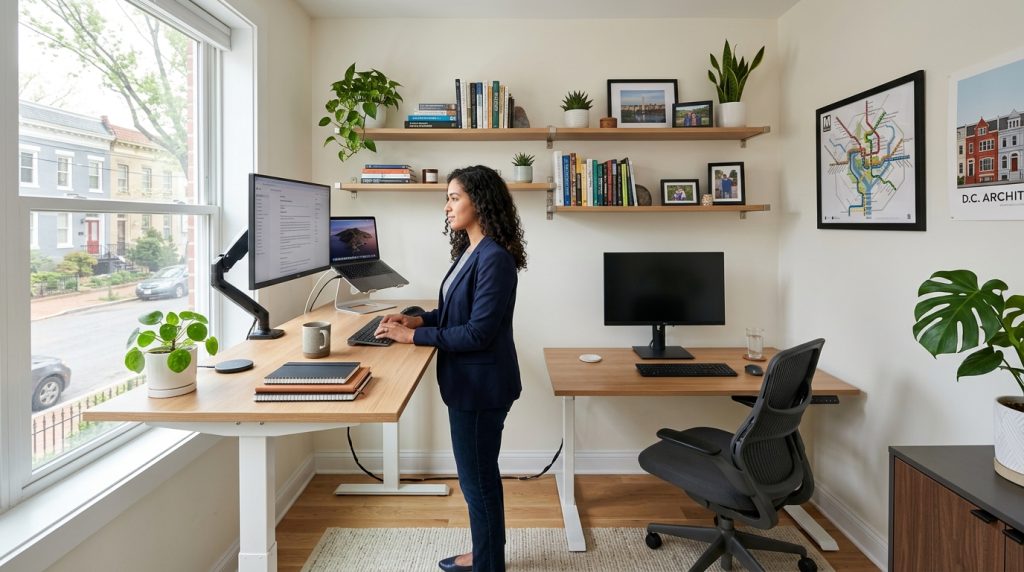
A smaller office does not benefit from furniture that serves a single purpose. Tables that transition from individual work to small group meetings, storage that doubles as room dividers, and sit-stand desks that allow the same workstation to serve multiple employees at different times all extract more value from limited square footage. Every piece in a compact office should justify its footprint with more than one function.
Vertical Space Is Underused in Most Small Offices
Organizations transitioning to smaller offices consistently overlook vertical storage. Wall-mounted shelving, overhead storage units, and tall credenzas move storage off the floor and free usable work surface without consuming additional square footage. In offices where floor space is constrained, the walls become the primary storage infrastructure.
Right-Sizing Workstations Without Sacrificing Productivity
Standard workstation footprints designed for desktop towers and paper-heavy workflows are larger than modern work requires. Contemporary employees working primarily on laptops need less surface area than previous generations. Compact desk options that provide adequate work surface for current technology without the excess depth of older designs allow more workstations in the same footprint without crowding.
Designing for Focus in Closer Quarters
Smaller offices place employees in closer proximity, which increases the risk of noise and distraction interfering with focused work. Furniture choices that incorporate acoustic panels, partial-height screens, and layout strategies that separate noisy collaboration zones from quiet focus areas preserve productivity in dense configurations. Proximity does not have to mean constant interruption.
Making the Most of Every Square Foot
A well-designed smaller office outperforms a larger one filled with furniture chosen without intention. The organizations that make this transition successfully treat the smaller footprint as a design constraint that produces a sharper, more functional workspace rather than a compromise.
Ready to get more out of less space? Contact us at All Business Systems for office furniture solutions designed to maximize smaller footprints without sacrificing function or appearance.