
Maximizing Small Office Spaces in DC and Northern Virginia
Washington DC and Northern Virginia are home to countless historic buildings with undeniable charm—and equally undeniable spatial challenges. From Georgetown rowhouses converted to offices to Alexandria’s Old Town commercial spaces, businesses throughout the region must work with tight stairwells, low ceilings, and floor plans that predate modern office concepts. The key to success isn’t fighting these constraints but selecting furniture that works with them.
Assessing Your Space Constraints
Before purchasing a single piece of furniture, measure everything. In historic buildings, you can’t assume standard dimensions for anything. Doorways may be narrower than modern frames, ceiling heights can vary from room to room, and floor plans rarely feature the right angles we take for granted in newer construction.
Pay special attention to delivery routes. That perfect conference table won’t matter if it can’t navigate your building’s 19th-century staircase. Measure stairwell widths at their narrowest points, note any turns or landings, and check ceiling heights along delivery paths. Many DC-area furniture disasters happen not in the office itself but on the journey there.
Document your measurements with photos. Visual references help when consulting with furniture specialists and prevent costly ordering mistakes. Include images of architectural details that might affect furniture placement—radiators, columns, unusually positioned windows, or original molding you want to preserve.
Furniture Strategies for Tight Quarters
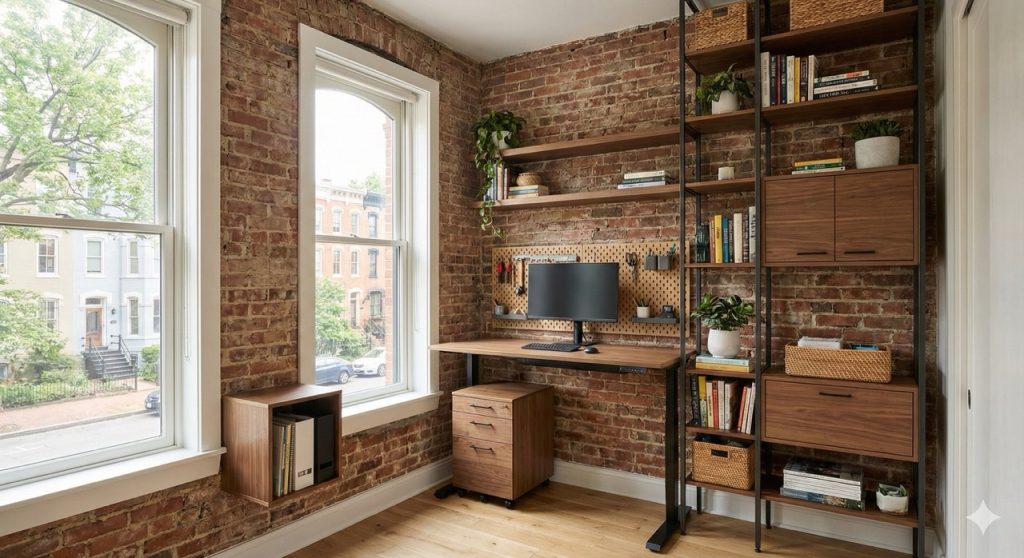
Small spaces demand furniture that works harder. Quality standing desks with minimal footprints provide essential workspace without overwhelming tight quarters. Look for models with slim profiles and built-in storage to eliminate the need for separate filing cabinets.
Multi-functional pieces are your allies in space-constrained offices. Consider benching systems that accommodate multiple workers in the footprint traditional individual desks would require. Nesting tables provide conference space when needed and disappear when not in use. Wall-mounted solutions—from desks to storage systems—free up valuable floor space in cramped quarters.
Vertical space becomes critical when horizontal space is limited. Tall, narrow storage units take advantage of high ceilings common in older buildings. Wall-mounted shelving systems provide storage without consuming floor area. Just be sure to check with building management about wall-mounting capabilities—some historic buildings have restrictions on what you can attach to walls.
Creating Flow in Irregular Layouts
Historic buildings rarely offer the open floor plans of modern office spaces. Instead, you’re working with a series of connected rooms, each with its own quirks. Embrace this by creating distinct zones rather than fighting for open-plan uniformity.
Use furniture to define spaces within spaces. Low-profile room dividers can create privacy in shared areas without blocking light or making rooms feel smaller. Modular seating arrangements help separate collaborative zones from focused work areas, even in compact rooms.
Consider furniture scale carefully. Oversized pieces make small rooms feel cramped, but furniture that’s too petite can make professional spaces feel like dollhouses. Aim for pieces that fit the room proportionally while serving their functional purpose completely.
Maintaining Professional Aesthetics
Working with spatial limitations doesn’t mean sacrificing professionalism. In fact, thoughtfully furnished small spaces often make stronger impressions than poorly planned large ones. Clients and employees alike appreciate offices that maximize their square footage intelligently.
Choose furniture with clean lines and minimal visual weight. Glass surfaces, light woods, and streamlined metal frames keep spaces feeling open. Dark, heavy furniture can make small rooms feel cave-like—particularly problematic in buildings with smaller windows than modern construction.
Resist the temptation to fill every square foot. Negative space matters, especially in compact offices. A few well-chosen, properly scaled pieces create a more professional impression than cramming in maximum furniture regardless of fit.
Working With Building Limitations
Historic buildings come with character—and restrictions. Many have limitations on modifications, weight loads, or cosmetic changes. Before finalizing furniture selections, understand what your lease or building regulations allow.
Floor load capacity matters, particularly in older buildings. Heavy furniture concentrated in small areas can exceed weight limits. Consult with building management about any restrictions, especially for upper floors.
Ready to upgrade your office furniture? Contact us at All Business Systems for expert advice on maximizing your unique space.