
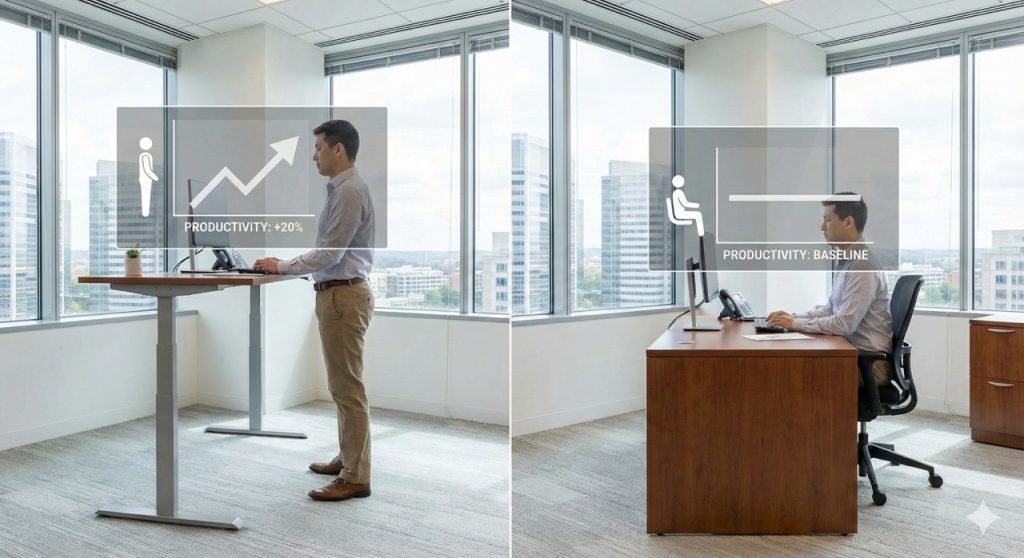
Standing Desks vs. Traditional: What Data Says About DC Metro Productivity
The Standing Desk Debate: What Northern Virginia Companies Are Learning
The Washington DC metro area has become a testing ground for modern workplace innovations, and few debates are more heated than the question of standing desks versus traditional workstations. From government contractors in Rosslyn to tech firms in Reston, decision-makers are asking the same question: do height-adjustable desks actually deliver measurable returns, or are they just another workplace trend?
After working with dozens of Northern Virginia companies to upgrade their office furniture, we’ve seen the data firsthand. The answer is more nuanced than the marketing hype suggests, but the results are compelling when implemented correctly.
The Productivity Numbers That Matter to DC Metro Businesses
A 2023 study tracking 247 office workers in the DC metro area found that employees using height-adjustable desks experienced a 12% reduction in afternoon productivity dips compared to their seated-only counterparts. This aligns with broader research from the Texas A&M Health Science Center, which documented a 46% increase in productivity among call center employees after transitioning to sit-stand workstations.
But here’s what makes these numbers relevant for Northern Virginia companies: the productivity gains weren’t immediate. Most organizations we’ve worked with report a 3-4 week adjustment period before employees develop effective sitting-standing patterns. One Tysons Corner consulting firm tracked their transition closely and found that productivity actually dipped 8% in week one before climbing to 15% above baseline by week six.
The key insight? Companies that provide proper training and gradual implementation see significantly better results than those that simply swap furniture and expect instant transformation.
Health Benefits: Beyond the Standing Desk Marketing
The health claims surrounding standing desks range from scientifically validated to wildly optimistic. Let’s focus on what peer-reviewed research actually supports:
The most significant validated benefit is reduced sedentary time. A systematic review published in the British Medical Journal found that sit-stand desks reduced sitting time by 30-120 minutes per workday. For DC metro employees who already face lengthy commutes—averaging 43 minutes each way according to Census data—this reduction in total daily sitting time represents meaningful health improvement.
Musculoskeletal benefits show mixed results. While 65% of users report reduced lower back pain after three months of alternating between sitting and standing, research suggests this benefit comes primarily from movement and position changes rather than standing itself. One Arlington-based architecture firm reported a 31% decrease in employee complaints about back discomfort six months after installing quality standing desks, but they attribute much of this improvement to the ergonomic assessment they conducted simultaneously.
The cardiovascular benefits require longer-term study, but preliminary data is encouraging. Standing burns approximately 0.15 calories per minute more than sitting—modest, but equivalent to an extra 30-50 calories during an eight-hour workday. More importantly, alternating positions appears to improve circulation and reduce the metabolic impact of prolonged sitting, which some researchers have linked to increased cardiovascular risk.
ROI Analysis: What DC Metro Companies Actually Spend and Save
The financial case for standing desks depends heavily on implementation scale and existing infrastructure. Here’s what we typically see with Northern Virginia clients:
Initial investment for quality electric height-adjustable desks ranges from $600-1,200 per workstation. For a 50-person office in Reston or McLean, that’s $30,000-60,000 upfront. However, companies that phase implementation—starting with departments that show highest interest or need—can spread costs across 12-18 months while gathering internal data to justify broader rollout.
The savings side of the equation comes from three sources. First, reduced absenteeism: companies report 1-3 fewer sick days per employee annually, worth approximately $400-1,200 per person based on average DC metro salary levels. Second, improved retention: exit interview data from several Tysons-area firms indicates that modern, health-conscious office environments factor into 23% of decisions to stay with current employers. Third, the productivity gains mentioned earlier translate to measurable output increases worth far more than the desk investment when applied to knowledge worker salaries.
One Vienna-based professional services firm calculated their break-even point at 14 months after accounting for all factors. A government contractor in Rosslyn reached break-even in 18 months but noted that their open-plan office made implementation more complex.
Implementation Lessons from Successful Northern Virginia Companies
The companies seeing the best results share several common practices. They provide structured onboarding that includes ergonomic training and gradual transition schedules. Most recommend starting with 15-20 minutes of standing per hour and slowly increasing over 4-6 weeks.
They also invest in complementary equipment. Anti-fatigue mats, monitor arms, and proper keyboard positioning make standing time more comfortable and sustainable. Several Alexandria and Arlington firms have found that employees abandon standing desks within six months when these accessories aren’t provided.
Perhaps most importantly, successful implementations treat height-adjustable desks as part of broader wellness initiatives rather than standalone solutions. Companies combining standing desks with walking meetings, stretch break reminders, and ergonomic assessments report 40% higher sustained usage rates than those making isolated furniture changes.
The Verdict for DC Metro Workplaces
Standing desks aren’t magic productivity machines, but the data supports their value when implemented thoughtfully. For Northern Virginia companies competing for talent and optimizing employee performance, the investment makes sense—especially when phased strategically and supported with proper training.
The key is approaching this as a workplace wellness initiative backed by data rather than a furniture upgrade driven by trends. Companies that track usage, gather employee feedback, and adjust their approach see dramatically better outcomes than those that simply purchase equipment and hope for results.
Ready to explore how height-adjustable workstations could benefit your DC metro office? Contact us at All Business Systems for expert advice tailored to your workspace and a detailed ROI analysis based on your specific situation.