
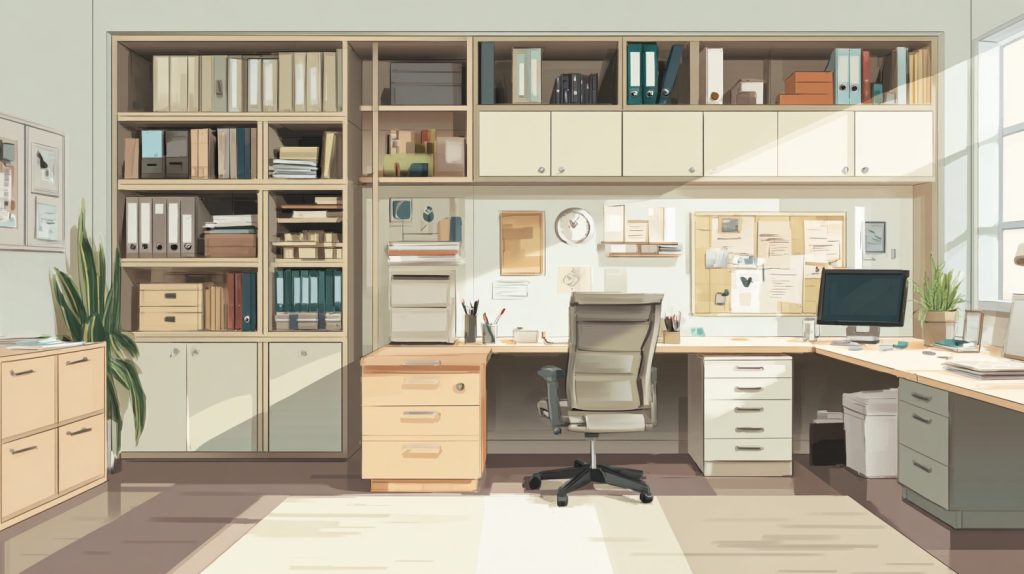
Storage Solutions That Reduce Office Clutter Without Reducing Productivity
Storage Solutions That Reduce Office Clutter Without Reducing Productivity
Clutter plagues Northern Virginia and DC metro offices, consuming workspace, creating visual chaos, and hiding important materials exactly when needed. The typical response—removing storage and demanding employees “go paperless”—often backfires. Effective teams need reference materials, work-in-progress documents, and tools accessible immediately. The solution isn’t eliminating storage but implementing smarter storage furniture that reduces clutter while supporting productivity.
Understanding the Productivity-Clutter Relationship
Not all visible materials constitute problematic clutter. Research distinguishes between functional accessibility (keeping frequently-used items within reach) and disorganized accumulation (retaining unnecessary materials without system). The former supports efficiency. The latter impedes it. For DC area businesses, furniture strategies must honor this distinction rather than simply hiding everything.
Problems arise when workspaces lack adequate purposeful storage, forcing employees to choose between cluttered desks covered with needed materials or time wasted retrieving items from distant storage. Quality furniture solutions eliminate this false choice, providing sufficient accessible storage that supports clean work surfaces alongside immediate access to necessary materials.
Personal Storage Scaled to Actual Needs
Standard workstation storage—a small pedestal with two or three drawers—works for minimal-paper roles but fails for positions requiring reference materials, supplies, or work-in-progress files. Rather than forcing universal storage quantities, match storage furniture to actual job requirements. Sales teams need different storage than accounting departments. Project managers require different solutions than programmers.
For Northern Virginia businesses, conducting storage needs analysis by role prevents both clutter (insufficient storage) and waste (excessive unused storage furniture). This analysis reveals that rather than uniform furniture, you need varied storage solutions deployed strategically based on team functions.
Mobile Storage That Moves With Work
Static storage in distant closets or file rooms guarantees two outcomes: underutilization and desk clutter. Materials needed frequently stay at workstations rather than traveling to storage after each use. Mobile storage furniture eliminates this problem. Rolling pedestals, mobile file cabinets, and cart systems position storage wherever work happens, then roll away when projects complete.
For DC metro offices embracing flexible workspace arrangements, mobile storage proves essential. In hot-desking or free-address environments, employees roll personal storage to whatever desk they occupy. At day’s end, storage rolls to lockers or storage zones. This mobility maintains clean shared work surfaces while ensuring everyone has necessary materials accessible.
All Business Systems provides mobile storage solutions that complement flexible workspaces, including mobile pedestals that pair perfectly with our standing desks for complete workstation mobility throughout your Northern Virginia office.
Vertical Storage Maximizing Space Efficiency
Floor space costs more than vertical space. Tall storage units, wall-mounted systems, and overhead storage leverage underutilized volume, reducing clutter without consuming valuable square footage. For Northern Virginia companies in expensive real estate markets, vertical storage strategies directly impact occupancy costs by reducing space needed for equivalent storage capacity.
Modern vertical storage solutions range from floor-to-ceiling shelving to wall-mounted cabinets to overhead bins above workstations. The key is accessibility—vertical storage must allow easy retrieval without requiring step stools or awkward reaching that discourages use. Quality systems incorporate pull-down mechanisms, sliding components, or strategic organization placing frequently-used items at convenient heights while relegating occasional-use materials higher.
Shared Storage for Team Materials
Not everything requires personal storage. Reference libraries, supply inventories, and project archives serve entire teams. Shared storage furniture consolidates these materials efficiently while maintaining accessibility. For DC area offices, shared storage often proves more economical than duplicating reference materials at every workstation.
Effective shared storage requires intentional organization and clear ownership. Someone maintains the system, ensuring materials stay organized and accessible. Location matters too—position shared storage centrally within teams using it rather than in distant corners where it becomes inconvenient and underutilized.
Concealed Storage Maintaining Visual Calm
Open shelving provides easy access but creates visual clutter when contents are visible constantly. Closed storage with doors or drawers conceals contents, maintaining clean aesthetics while preserving storage capacity. For Northern Virginia businesses where office appearance matters—particularly in client-facing areas—closed storage furniture maintains professional impressions.
Balance open and closed storage based on contents and visibility. Decorative items and organized materials display well on open shelving. Working files, supplies, and personal items store better in closed cabinets. This mixed approach provides visual interest through curated displays while concealing mundane necessities.
Activity-Based Storage Supporting Varied Tasks
Different work activities require different storage solutions. Focused individual work benefits from personal desk storage. Collaborative project work needs shared accessible storage near team areas. Meeting preparation requires staging areas where materials gather before sessions. For DC metro businesses with diverse work modes, furniture supporting these varied storage needs reduces clutter across all activities.
Consider creating storage zones matching activity areas. Personal storage at individual workstations. Project storage in collaborative zones. Shared reference storage in quiet areas. Supply storage near high-use equipment. This distributed approach positions storage where naturally needed rather than centralizing everything in distant closets.
Digital-Physical Integration Reducing Paper Volume
While going entirely paperless proves unrealistic for most businesses, reducing paper storage needs through smart digital integration helps. Furniture supporting this transition includes scanning stations with immediate shredding, tablet docking systems that reduce printed reference needs, and reduced personal filing in favor of digital-first workflows with minimal paper backup.
For Northern Virginia companies, this integrated approach acknowledges that digital and physical information both serve purposes. Furniture strategies should facilitate appropriate format for each use case rather than forcing artificial digital-only policies that employees circumvent through workarounds creating different clutter problems.
Storage Furniture That Grows With Changing Needs
Business storage requirements fluctuate. Projects generate temporary material accumulation. Regulatory changes create new retention requirements. Team growth increases storage demand. Modular storage furniture accommodates these changes without complete replacement. Add storage units to existing systems. Reconfigure existing components for different uses. Expand capacity incrementally rather than in disruptive overhauls.
For DC area businesses, this flexibility proves particularly valuable during growth phases. Rather than guessing future storage needs and over-investing preemptively, start with adequate initial storage and expand systematically as actual needs become clear.
Measuring Storage Strategy Success
How do you know if storage furniture investments succeed? Visual assessment provides immediate feedback—are work surfaces clear and usable? Can employees locate needed materials quickly? Do storage solutions get used rather than bypassed? Employee feedback reveals whether systems support their work or create obstacles.
For Northern Virginia companies, successful storage furniture delivers three outcomes: reduced visible clutter, improved material accessibility, and employee satisfaction with their ability to organize work effectively. When all three align, storage investment proves its value.
Ready to solve clutter challenges while maintaining productivity? Contact us at All Business Systems for expert guidance on storage furniture solutions tailored to your Northern Virginia or DC metro office needs.