
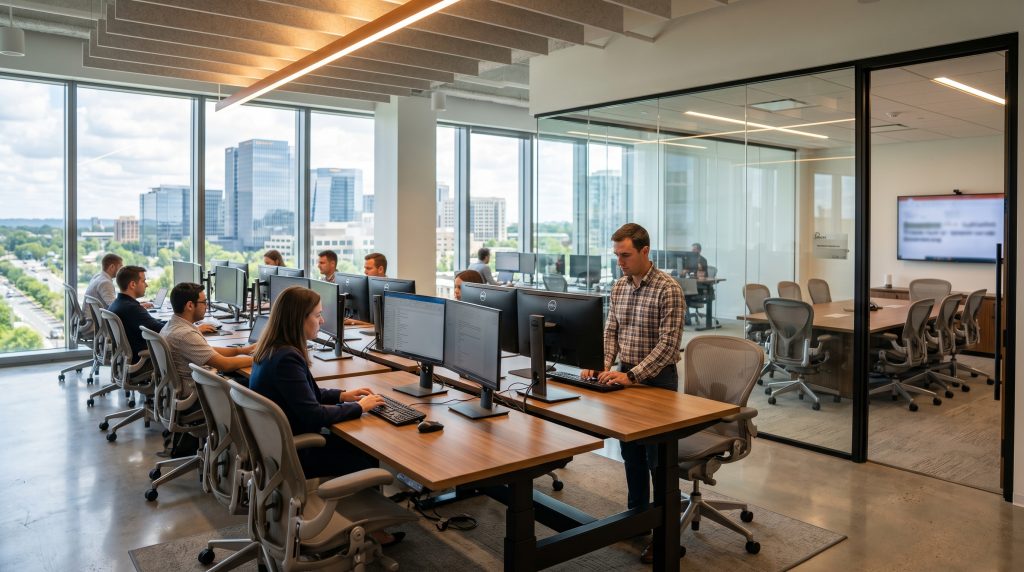
Multi-Location Consistency: Standardizing Office Furniture Across Northern Virginia Branches
If your organization operates two, five, or fifteen offices across Northern Virginia and the Washington DC metro area, you already know the challenge: each location has its own personality, its own history, and often its own mismatched collection of office furniture accumulated over the years. While a little variety is natural, inconsistency in your physical workspaces can quietly undermine your brand, your culture, and your productivity.
Standardizing office furniture across multiple locations is not simply an aesthetic exercise. It is a strategic decision that pays dividends in employee satisfaction, operational efficiency, and the professional impression you make on every client or visitor who walks through any of your doors.
Why Furniture Consistency Matters Across Branch Locations
Think about the experience of an employee who transfers from your Tysons Corner office to your Reston branch, or a manager who rotates between your Arlington headquarters and a satellite office in Fredericksburg. When the furniture, layout logic, and ergonomic standards differ dramatically from one site to the next, that transition creates friction. Employees have to relearn where things are, adapt to chairs that fit differently, and work at desks that may not support their health the way their previous setup did.
Consistency eliminates that friction. When your standard workstation looks and functions the same whether it is in McLean or Manassas, your team members hit the ground running at every location. Beyond the individual experience, consistent furniture communicates something powerful to clients: this organization is cohesive, professional, and invested in its operations. That impression carries weight, especially in the competitive Northern Virginia business environment where federal contractors, technology firms, and professional service providers are all vying for top-tier talent and client relationships.
The Brand Alignment Argument
Your physical workspace is an extension of your brand. The colors, materials, and overall aesthetic of your furniture should reflect your company identity just as clearly as your logo or website does. When a prospective client visits your office in Fairfax and then your satellite location in Woodbridge, they should encounter the same visual language and the same level of quality.
Disjointed furniture across locations sends an unintended signal: that different parts of the organization are operating independently, perhaps even that some locations are more valued than others. Standardization corrects that signal and reinforces the message that every office, and every employee in it, matters equally to leadership.
Practical Strategies for Standardizing Across Multiple Sites
Getting from a patchwork of furniture across your Northern Virginia branches to a cohesive, standardized environment does not have to happen overnight. Here are the approaches that work best for multi-location organizations in this region.
Start with a furniture audit. Before purchasing anything new, document what exists at each location. Note the condition, age, and brand of existing pieces. This gives you a clear picture of what needs to be replaced immediately versus what can remain in service during a phased rollout.
Establish a master specification. Work with your furniture provider to define a standard specification document that covers workstations, seating, conference furniture, and collaborative areas. This document becomes the blueprint for every future purchase and renovation. It should include approved finishes, dimensions, and ergonomic standards. For desk specifications, consider including sit-to-stand desks from All Business Systems, which give employees the flexibility to alternate between sitting and standing throughout the workday — a standard that promotes wellness across every location equally.
Phase your rollout strategically. Rather than attempting a full refresh of all locations simultaneously, prioritize by highest visibility or greatest need. Client-facing spaces and conference rooms at each branch are natural starting points because they have the most immediate impact on perception. Employee workstations can follow in subsequent phases as budget allows.
Account for spatial differences. Standardization does not mean identical. Your Tysons high-rise floor plan is likely very different from your smaller Springfield satellite office. A good standardization strategy establishes consistent furniture families — the same desking system, the same chair line, the same conference table series — while allowing configuration to adapt to each space’s footprint.
Centralize procurement. One of the most practical benefits of a standardization strategy is the purchasing leverage it creates. When you commit to a single furniture line across all your Northern Virginia locations, you gain the ability to negotiate volume pricing, streamline reordering, and simplify warranty management. A local partner like All Business Systems can manage this process on your behalf, coordinating delivery and installation across multiple sites on a schedule that minimizes disruption to your operations.
Ergonomics as a Non-Negotiable Standard
Any standardization initiative should treat ergonomics as a foundational requirement, not an optional upgrade. Musculoskeletal injuries and discomfort from poor workstation setups are among the leading causes of workplace productivity loss and absenteeism. When you standardize, you have an opportunity to set a high ergonomic bar across all your locations at once.
This means selecting task chairs with adjustable lumbar support, seat height, and armrests that can accommodate a wide range of body types. It means specifying monitor arms or adjustable monitor stands as part of every workstation package. And increasingly, it means incorporating height-adjustable desks as part of the standard specification, so that every employee at every branch has the same opportunity to work in a way that supports their long-term health.
How All Business Systems Supports Multi-Location Clients
All Business Systems has been serving organizations throughout Northern Virginia and the Washington DC metro area for decades. We understand the unique demands of multi-location furniture programs because we have managed them for federal agencies, technology companies, law firms, healthcare organizations, and more across the region.
Our team can work with your facilities or operations leadership to develop a master specification, conduct on-site assessments at each of your Northern Virginia branches, and create a phased implementation plan that fits your timeline and budget. We coordinate delivery, installation, and furniture removal across multiple sites, and we maintain the relationships with leading manufacturers that allow us to offer competitive volume pricing to multi-location clients.
Whether you are standardizing three offices or thirty, the goal is the same: every employee at every location should sit down to work in an environment that reflects your organization’s values and supports their best performance.
Ready to upgrade your office furniture? Contact us at All Business Systems for expert advice and top-quality solutions.