
Storage as Strategy: Smart Filing, Shelving, and Cabinetry Solutions for Paperwork-Heavy Offices
When Storage Becomes a Business Problem
If you work in a law firm, government agency, insurance company, or compliance-driven organization in the DC metro area, you already know the problem. Case files stack up on credenzas. Regulatory binders crowd shared shelving. Client records migrate from filing cabinets to cardboard boxes to the floor of a conference room nobody wants to use anymore. What started as a storage issue becomes a workflow bottleneck — and in regulated industries, it can become a liability.
For offices in Northern Virginia and the Washington DC area, where the density of legal, federal contracting, insurance, and compliance work is genuinely unlike anywhere else in the country, storage is not a secondary concern. It is infrastructure. Getting it right means getting it intentional.
The Filing System Most Offices Are Still Using (And Why It Fails)
The standard two- or four-drawer lateral file cabinet has served offices faithfully for decades. It still has a place — but relying on it exclusively in a paperwork-heavy environment is a bit like routing all your office internet through a single cable modem. It works until it doesn’t, and when it fails, it fails loudly.
Common symptoms of a filing system that has outgrown itself include: staff spending more than a few minutes locating a specific file, duplicate records appearing because no one is certain where the original lives, shared filing areas that serve as a catch-all rather than a retrieval system, and conference rooms pressed into service as overflow storage. These are solvable problems, but they require a systems-level approach rather than just ordering more cabinets.
Modular Shelving: Flexibility That Grows With Your Caseload
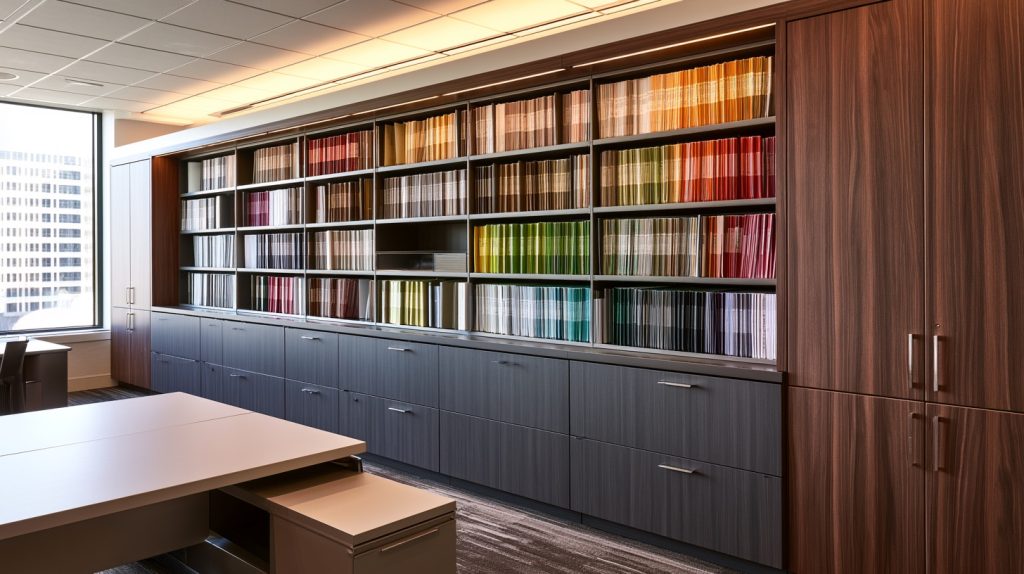
Open-shelf filing systems — the kind used extensively in legal and medical environments — offer significantly higher storage density per square foot than traditional lateral files. Where a row of four-drawer laterals might consume 40 linear inches of wall space for roughly 1,500 folders, a well-configured open-shelf unit in the same footprint can hold two to three times that volume.
For government contractors in Fairfax, Reston, or Arlington managing contract compliance documentation, or for insurance offices in Tysons that maintain policy records by client or by renewal cycle, modular open shelving with labeled bays and color-coded file guides turns retrieval into a repeatable process rather than a search exercise.
High-density mobile shelving — systems mounted on floor tracks that eliminate fixed aisles — is another option worth considering for offices with significant square footage constraints. These systems are common in federal agency records rooms and larger law firm file centers for exactly that reason.
Cabinetry That Serves Compliance, Not Just Aesthetics
In regulated environments, not all documents can live on open shelves. Client files, HR records, financial documents, and materials subject to confidentiality requirements need secured storage. Locking lateral and vertical file cabinets remain the appropriate solution here, but the selection matters more than most offices acknowledge.
Key considerations include weight capacity and drawer suspension quality (cheaper cabinets fail prematurely under heavy daily use), key control systems for environments where access needs to be auditable, fire-rated options for irreplaceable records, and finish and sizing that integrates with the broader workspace rather than looking like it was delivered to the wrong address.
Credenzas and storage credenzas with lockable lower cabinets are also worth evaluating for private offices and executive suites. They provide accessible working storage at desk height while maintaining a professional appearance — important in client-facing environments common to DC-area law firms, financial services firms, and consulting practices.
Pairing Storage With the Right Workstation Setup
Storage strategy doesn’t exist in isolation. It connects directly to how workstations are configured. An attorney or analyst who keeps active files close at hand needs a desk setup that accommodates both work surface and immediate-access storage without creating clutter. Pedestal file drawers built into or positioned under the primary desk are a straightforward solution, but the pedestal needs to match the desk in both dimension and finish to maintain a cohesive workspace.
For staff who spend long hours at their desks pulling, reviewing, and re-filing documents, height-adjustable standing desks pair naturally with under-desk storage pedestals and nearby shelving, allowing workers to shift posture throughout the day without losing access to the files they need at any given moment.
Designing Storage Into the Office Layout From the Start
The most common and most expensive storage mistake is treating it as an afterthought — buying furniture first and then figuring out where records will live. For offices undergoing a build-out, reconfiguration, or significant expansion, storage planning belongs in the conversation from the beginning.
That means mapping the workflow: where documents originate, where they are actively used, where they are held during a matter or case, and where they go for long-term retention or off-site archiving. It means estimating growth. A DC-area law firm that opens a new practice group or a federal contractor that wins a new IDIQ vehicle will generate records at a rate that surprises teams who didn’t plan for it.
It also means working with a supplier who understands both the furniture side and the operational side of paperwork-heavy environments — not just a vendor who ships cabinets.
What Smart Storage Actually Looks Like
For a legal or compliance-driven office in Northern Virginia or the DC metro area, a well-designed storage system typically combines open-shelf filing in high-volume records areas, locking lateral cabinetry for confidential or regulated documents, integrated desk pedestals for active working files, credenza storage in private offices and conference rooms, and a clear labeling and retrieval convention that staff can follow consistently. It is not complicated. But it requires that someone make deliberate decisions about each element rather than ordering what was used at the last office.
Ready to upgrade your office furniture? Contact us at All Business Systems for expert advice and top-quality solutions.