
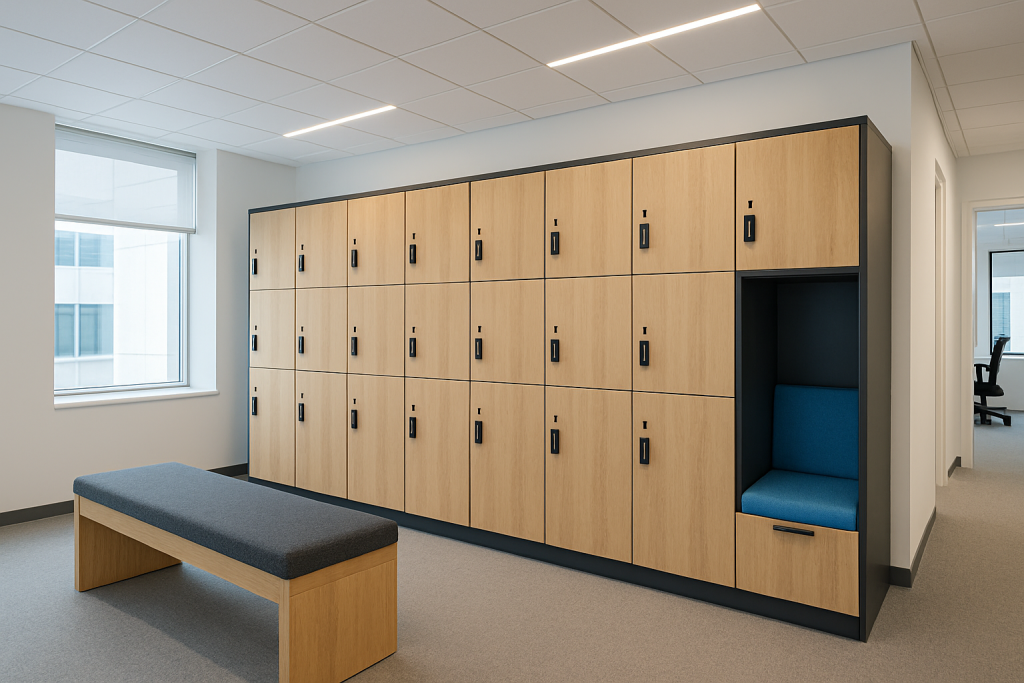
The Workplace Locker Room: Storage for Hybrid Workers
As organizations adapt to hybrid work models, a significant challenge has emerged: how to efficiently manage personal belongings and work tools in spaces that are no longer permanently assigned to individuals. The modern workplace increasingly resembles a well-designed locker room—providing personalized storage solutions that accommodate the coming-and-going nature of today’s workforce while maximizing space efficiency and supporting organizational culture.
The Evolution of Workplace Storage
Traditional office storage was designed for a static workforce—permanent desk pedestals, personal filing cabinets, and dedicated shelving reflected the assumption that employees would occupy the same space day after day. The shift toward hybrid work has rendered this approach obsolete, creating the need for storage solutions that are:
Adaptable: Serving different employees on different days
Secure: Protecting personal and confidential items even during extended absences
Space-efficient: Accommodating more people within the same physical footprint
Technology-integrated: Supporting the tools and devices of modern work
Modern Personal Storage Solutions
Today’s workplace lockers bear little resemblance to the utilitarian metal boxes found in school hallways. Contemporary personal storage solutions have evolved to meet multiple needs while complementing sophisticated office aesthetics:
Smart Lockers: Digital locking systems controlled via employee badges, smartphone apps, or biometrics eliminate key management headaches while providing detailed usage analytics. These systems can automatically reassign lockers based on reservation schedules, maximizing utilization.
Neighborhood Lockers: Departmental or team-based storage zones create natural gathering points and reinforce team identity in otherwise fluid workspace layouts. These arrangements often include a mix of personal storage and shared resource storage relevant to specific team functions.
Technology-Enabled Storage: Built-in charging stations, ventilation for electronic devices, and antimicrobial surfaces address the needs of a tech-dependent workforce. Some advanced units even incorporate UV sanitizing features for frequently used items.
Multi-Function Solutions: Storage walls that double as space dividers, acoustic panels, or even digital display surfaces maximize the utility of storage investments. These integrated solutions turn necessary storage into design features rather than afterthoughts.
Psychological and Cultural Benefits
Beyond practical considerations, well-designed personal storage delivers significant psychological and cultural benefits:
Territorial Anchoring: Having a dedicated, personal space—even if modest in size—helps employees feel connected to the physical workplace despite irregular attendance patterns. This psychological anchoring increases engagement and reduces the disorientation some experience in hot-desking environments.
Status Neutralization: Uniform personal storage can help flatten perceived hierarchies and promote a more egalitarian culture, especially when executive offices are eliminated in favor of shared workspaces. When everyone from the CEO to the newest hire uses the same storage system, subtle signals of organizational values emerge.
Personalization Within Parameters: Well-designed locker systems often include customization options (digital nameplates, color-coded sections, internal organization systems) that allow individual expression while maintaining overall design cohesion.
Reduced Visual Clutter: Centralized storage keeps personal items contained rather than scattered across workspaces, creating a more professional environment and simplifying cleaning and maintenance routines.
Implementation Considerations
Organizations planning to upgrade their storage solutions for hybrid workers should consider several factors:
User Research: Conduct surveys and observations to understand what employees actually need to store, rather than making assumptions. The items hybrid workers bring to the office may differ significantly from what full-time on-site employees maintained in the past.
Size Variety: Provide different storage dimensions to accommodate various needs—from small secured compartments for valuables to larger spaces for backpacks, outerwear, or specialized equipment.
Ratio Planning: Most organizations find they need fewer lockers than total employees, as not everyone is present simultaneously. Data from space utilization studies can help determine the optimal ratio for your specific workforce patterns.
Location Strategy: Distribute storage throughout the workspace rather than concentrating it in a single area to prevent congestion and support natural movement patterns. Consider placing higher-use storage in premium locations with less frequently accessed storage in peripheral areas.
Clear Policies: Establish and communicate guidelines regarding locker assignment, duration of use, prohibited items, and cleaning protocols to prevent misunderstandings and ensure equitable access.
Ready to upgrade your office furniture? Contact us at All Business Systems for expert advice and top-quality solutions.